Do you need a permit?
It depends on what you build, how big it is, and where. We find out which rules apply before we design, and we handle the permits.
The short version
- Some rules are the same across Ontario, many are set by your town and differ town to town, and some depend on where your lot sits.
- A small storage shed can go without a building permit. A cabana or covered pavilion generally needs one once it is over 10 m² / about 108 sq ft.
- A deck by the house usually needs a permit once the walking surface is more than 60 cm / 24 in above the ground.
- No permit doesn’t mean no rules: zoning still applies.
Checked October 2026. General information, not legal advice. Rules change, and we confirm them for your property before we design.
Rules across Ontario
Sheds, cabanas, decks, retaining walls, electrical, gas and locates.
- Storage sheds
- No building permit if all of these are true: no more than 15 m² / 161 sq ft, one storey, not attached to a building or any other structure, used only for storage, and no plumbing.
- This comes from an Ontario Building Code change, O. Reg. 867/21, in effect since 29 April 2022.
- Cabanas, pool houses and covered pavilions
- A building permit is generally needed once it is over 10 m² / about 108 sq ft, or if it is attached to the house, or if it has plumbing. The 10 m² line comes from the Building Code Act’s definition of a building.
- Arbour, pergola, pavilion or cabana? Read the guide
- Decks
- A deck attached to or right beside the house usually needs a permit once the walking surface is more than 60 cm / 24 in above the ground. Your town sets the details.
- Retaining walls
- A wall more than 1 m / 3 ft 3 in of exposed height needs a permit when it is next to public property, the access to a building, or private property the public uses. It also needs drawings from a qualified designer, usually a professional engineer.
- Read our guide to building on a slope
- No permit doesn’t mean no rules
- Zoning still applies: how close to the lot line, how tall, how much of the lot you can cover.
- Electrical
- By law, electrical work for a homeowner must be done by a Licensed Electrical Contractor. They file the notification with ESA, and the work is inspected before it’s buried. Ask for the ESA Certificate of Acceptance.
- We bring in licensed electricians. Our own crew installs low-voltage lighting.
- Gas
- Gas lines for fire features, BBQs, heaters and pool heaters are run by licensed gas fitters we bring in.
- Locates
- Requesting utility locates is free and it’s the law. Request locates at least five business days before you dig. The service is now called Ontario Dig Authority (formerly Ontario One Call).
- Public locates cover the utilities’ lines, not lines you own, for example a gas line to a BBQ or wiring to a pool heater or lights. So we also book private locates where needed.
Set by your town
Pool enclosures, private trees, fences, grading and fill differ from town to town.
Here are the ones that come up most where we work.
- Pool enclosures
- Towns set their own pool enclosure by-laws, and the details differ: fence height, gates, distance from the water, how hot tubs are treated.
- Pool enclosures in Oakville
- You need a pool enclosure permit before you build or install a new pool.
- Pool enclosures in Hamilton
- Pool enclosures fall under By-law 16-184. Hot tubs need a rigid cover that can hold 90 kg / 198 lb, or an enclosure. A site alteration permit is also needed before Hamilton issues the pool enclosure permit.
- Private trees in Oakville
- A permit is needed to remove a tree with a trunk larger than 15 cm / 6 in in diameter at breast height.
- More on working in Oakville
- Private trees in Burlington
- Inside the urban area, a permit is needed to remove or injure a private tree 20 cm / 8 in or more in diameter. Digging, grading or storing materials inside the tree’s protection zone counts as injuring it.
- Private trees in Hamilton
- This includes Waterdown, Flamborough, Ancaster and Dundas. Older private tree by-laws apply in Ancaster and Dundas, and in 2026 the City has been working on a city-wide private tree by-law (draft sent to public consultation March 2026). We check what applies to your lot before we design.
- Arborist reports
- Where a tree permit needs an arborist report, we arrange it.
- Fences, grading and fill
- These are also set by the town.
Set by where your lot sits
Conservation authorities, the Niagara Escarpment and heritage.
- Conservation authorities
- If your lot is near a creek, wetland, floodplain, valley or shoreline, building or grading there can need a permit from the local conservation authority. Since 1 April 2024 they all work under one provincial regulation, O. Reg. 41/24.
- Some smaller work, like certain accessory structures and detached decks, can be exempt within size and location limits.
- The ones we work with are the Hamilton Conservation Authority, Conservation Halton and TRCA.
- On a slope or ravine? Read our slope guide
- Niagara Escarpment
- Lots in the Niagara Escarpment Commission’s development control area generally need an NEC development permit for building or site alteration, unless an exemption applies.
- Exemptions come with conditions: for example, a pool or hot tub can be exempt only if it meets setbacks from the lot line, size limits and the town’s fencing rules.
- The NEC doesn’t issue a letter confirming an exemption, and an exemption doesn’t replace a building permit or a conservation authority permit.
- More on working in Flamborough
- Heritage
- If a house is designated or in a heritage district, visible changes can need a heritage permit.
How we handle it
We flag likely permits at the discovery meeting, find out which apply before we design, and handle the permits: drawings, arborist reports and engineering when needed.
For a project where engineering was needed, read Ravine’s Edge.
See how it works, step by step
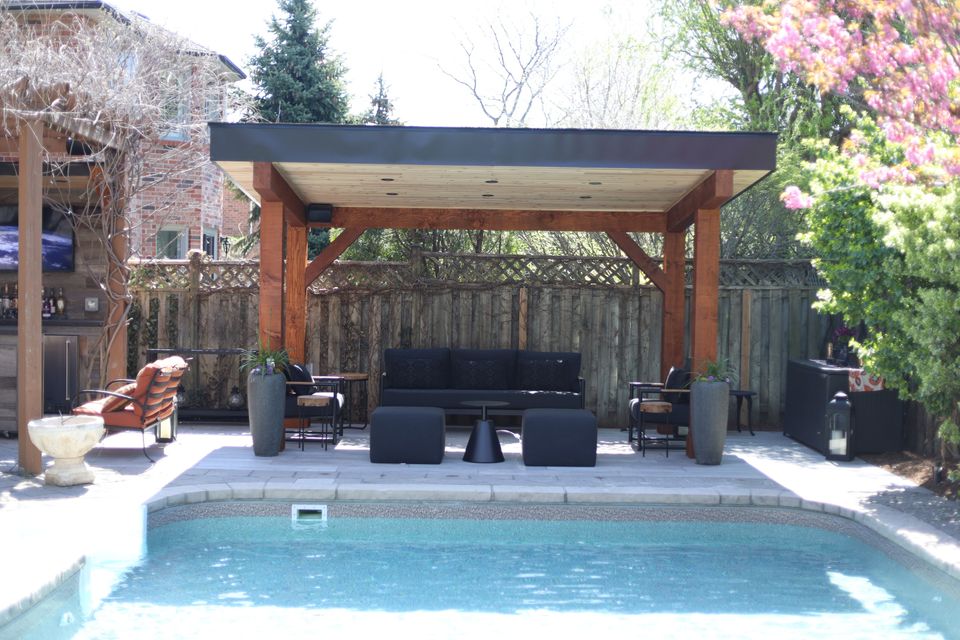
A real example: the pavilion at The Back Bar in Oakville was sized to go up without waiting on a permit.
Read The Back Bar storyCommon questions
Does a patio need a permit?
A patio laid on the ground usually doesn’t need a building permit, but zoning, grading and drainage, tree, and conservation authority or NEC rules can still apply.
Does a pergola or pavilion need a permit?
It depends on size, whether it has a roof and is attached, and your town. Covered and over 10 m² / about 108 sq ft: usually yes.
Do I need a permit for a hot tub?
It depends on the town. In Hamilton, a hot tub needs a rigid cover that holds 90 kg / 198 lb, or an enclosure.
What happens if I skip the permit?
The town can order changes or removal, and unpermitted work can come up when you sell.
Official sources
The by-laws and agencies behind this guide.
- Ontario Dig Authority
- ESA: notifications and inspections
- Oakville Pool Enclosure By-law
- Oakville Private Tree Protection
- Burlington Forest Protection and Tree Permits
- City of Hamilton, Harmonized Private Tree By-law
- Hamilton Conservation Authority on O. Reg. 41/24
- Niagara Escarpment Commission, pool and hot tub exemptions